
7 Best Office Door Security Upgrades to Consider
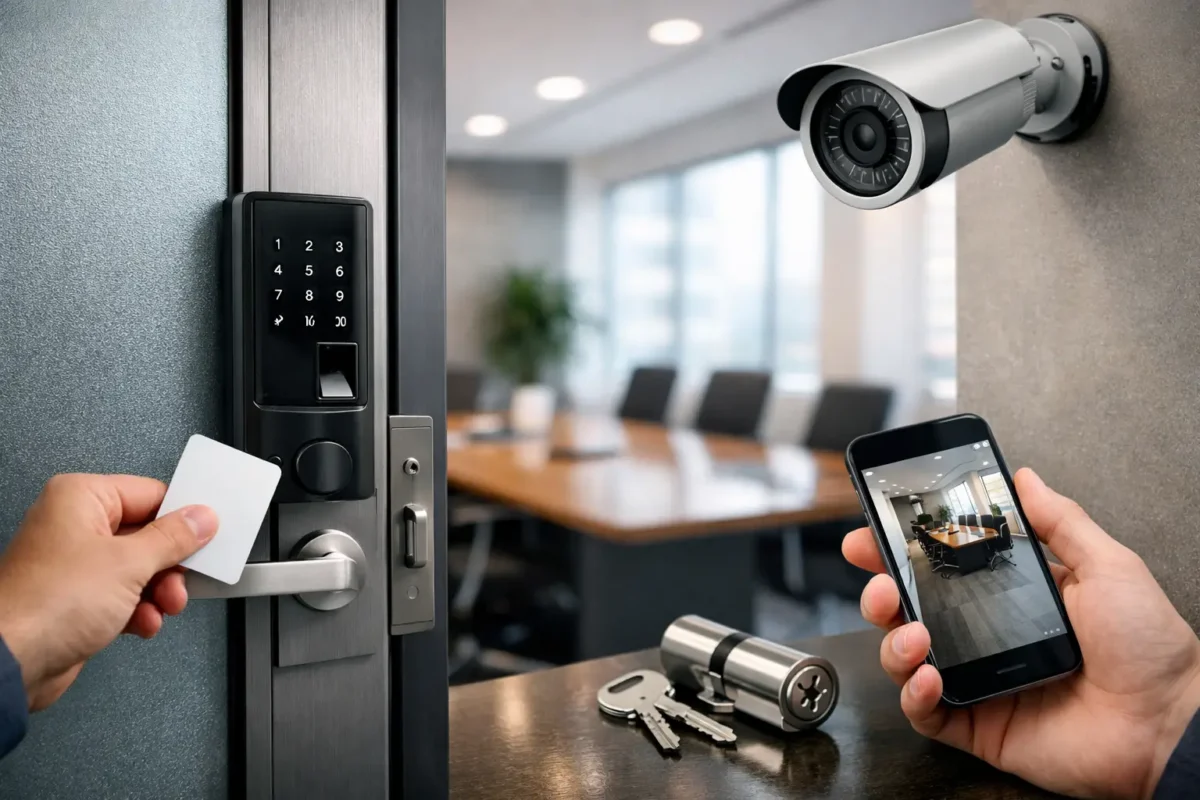
A front office door does more than separate your business from the sidewalk. It controls who gets near staff, customer information, equipment, inventory, and private work areas. The best office door security upgrades solve the weak points that create everyday risk: copied keys, worn hardware, doors that do not latch, and no clear record of who entered after hours.
For a small or mid-sized office, security does not have to mean turning the building into a fortress. The right approach is practical: strengthen the door, control access, and make sure authorized employees can still get in and out without confusion. Start with the entry points that are used most often, then build out from there.
1. Replace Basic Locks With Commercial-Grade Deadbolts
A residential-style lock may work on an interior office door, but it is not always the right choice for a main entrance or a door that faces a public hallway. Commercial-grade deadbolts and lever locks are built for frequent use and typically offer stronger internal components, better strike hardware, and a longer service life.
For an exterior office door, look at the whole locking system, not just the cylinder where the key goes. A quality deadbolt needs a solid bolt, a properly aligned strike plate, and a door frame that can support it. If the bolt barely reaches the frame or the door shifts when pulled, a new lock alone will not fix the problem.
This is often a good upgrade for offices with a small staff and limited access needs. It keeps the system familiar while improving physical security. However, it does not solve key tracking on its own. If several people carry copies of the same key, a lost key still creates a reason to rekey the lock.
2. Install Reinforced Strike Plates and Longer Screws
Many forced-entry attempts target the door frame, not the lock cylinder. A standard strike plate can be thin, loosely attached, or secured with short screws that only grip the trim. A reinforced strike plate transfers force deeper into the wall framing when it is installed correctly.
This upgrade is inexpensive compared with replacing an entire door, but it makes a real difference on outward-facing office entrances. Longer screws should reach the framing behind the jamb, not just the surface material. A locksmith can also correct alignment problems so the bolt enters the strike cleanly instead of catching on its edge.
Reinforcement is especially useful when a door has been slammed repeatedly, shows cracks around the frame, or has a history of sticking. It is a simple fix that supports every other security upgrade you make.
3. Move to Restricted Keyways for Better Key Control
Regular keys are easy to copy. An employee may have an extra made at a hardware store, a former tenant may still have a key, or a key may change hands without anyone keeping track. For offices handling customer records, tools, medication, cash, or sensitive equipment, that uncertainty is a problem.
Restricted key systems give business owners more control over duplication. Depending on the system, additional keys may require authorization through the locksmith or designated account holder. That means you can keep a clearer record of who has access and request keys when staffing changes.
Restricted keys are not necessary for every office. A one-person suite with no sensitive inventory may be better served by a high-quality deadbolt and a rekey after a move. But for property managers, medical offices, professional services, and businesses with several staff members, controlled key duplication can prevent a small access issue from becoming a larger one.
4. Add a Keypad or Smart Lock Where It Makes Sense
Keypad locks and smart locks can eliminate many of the hassles tied to physical keys. Instead of issuing a key to every employee, you can assign a code, create temporary access for a cleaner or contractor, and remove a user’s access when their role changes.
For a small office, a keypad lock can be a straightforward choice for the main entrance or a supply room. It works well when employees arrive at different times and the business wants to avoid managing multiple key copies. Many models can also provide an audit trail, showing when specific codes were used.
A smart lock should be selected for the door and the workplace, not just for the app features. Consider battery maintenance, how the lock operates during a power or internet interruption, and whether staff need access from outside business hours. Some offices prefer keypad-only hardware because it is simple and reliable. Others benefit from app-based management across multiple doors. Professional installation helps make sure the lock fits the door correctly and does not interfere with the existing latch, closer, or exit hardware.
5. Use Access Control for Multiple Employees or Doors
When an office has several employees, separate departments, or more than one entry point, access control is often the most useful long-term upgrade. Instead of relying on one shared key, staff can use cards, fobs, mobile credentials, or assigned codes. Access can be limited by person, door, and time of day.
For example, reception staff may need access to the front entrance and office area, while only managers can enter a records room or stock area. If a fob is lost, it can be removed from the system without changing every lock. That is a major advantage over traditional keys.
Access control also creates accountability. Entry records can help a business investigate a door left open, confirm contractor access, or review after-hours activity. It is not a replacement for good management practices, but it gives owners better information when questions come up.
The trade-off is planning. Access control requires the right hardware, power considerations, and clear policies for issuing credentials. Before installing a system, decide who will manage users and what happens when an employee leaves. A system is only as useful as the access rules behind it.
6. Upgrade the Door Closer, Hinges, and Exit Hardware
Security problems are often mechanical. A door that does not close fully can leave a latch disengaged. Loose hinges can cause alignment issues. A damaged closer may let a door drift open or slam hard enough to wear out locks and frames.
Door closers are particularly important on exterior and fire-rated doors. The closer should bring the door shut consistently and allow the latch to engage without requiring someone to pull or push it into place. If the door is difficult to open, shuts too fast, or will not latch unless someone adjusts it by hand, have the hardware inspected.
For emergency exits, safety requirements come first. Exit doors may need panic hardware that allows people to leave quickly without a key, code, or special knowledge. Do not add a lock or secondary device to an exit door without confirming that it complies with building and fire requirements. A locksmith can help identify hardware that improves security while preserving safe egress and ADA-friendly operation.
7. Secure Interior Doors and High-Value Areas
The front door is not the only door worth protecting. Server closets, records rooms, offices with payroll files, storage rooms, and areas holding expensive tools or products may need their own access plan. An interior lock with a basic privacy button is not designed to protect sensitive assets.
Depending on the room, an upgraded lever lock, restricted keyway, keypad lock, or access-control reader may be the right fit. The goal is not to make employees feel watched. It is to limit access to people who genuinely need it and reduce the impact of a lost key, visitor mistake, or unauthorized entry.
For shared buildings, also look at doors leading from common hallways, rear service entrances, and suite-to-suite connections. These doors are sometimes overlooked because they are not the main customer entrance, yet they may have less visibility and weaker hardware.
How to Choose the Right Office Door Security Upgrade
Start with a walkthrough of every door that leads outside, into a common building area, or toward sensitive office space. Check whether each door closes and latches on its own, whether keys are accounted for, and whether former employees or vendors could still have access. Those answers usually point to the first priority.
A basic office may only need rekeying, a commercial-grade deadbolt, and a reinforced strike plate. A growing company with staff turnover may benefit more from keypad access or fobs. If your business has several doors, changing schedules, or areas with different permission levels, access control can make daily management easier while reducing key-related headaches.
Do not wait for a break-in, lost master key, or employee departure to find out the hardware is outdated. A professional locksmith can assess the door, frame, lock, and exit requirements together, then recommend upgrades that fit how your office actually operates. For Denver Metro businesses, BS Locksmith can help put a practical security plan in place before a small door issue becomes a major disruption.