
Car Key Cutting Versus Programming Explained
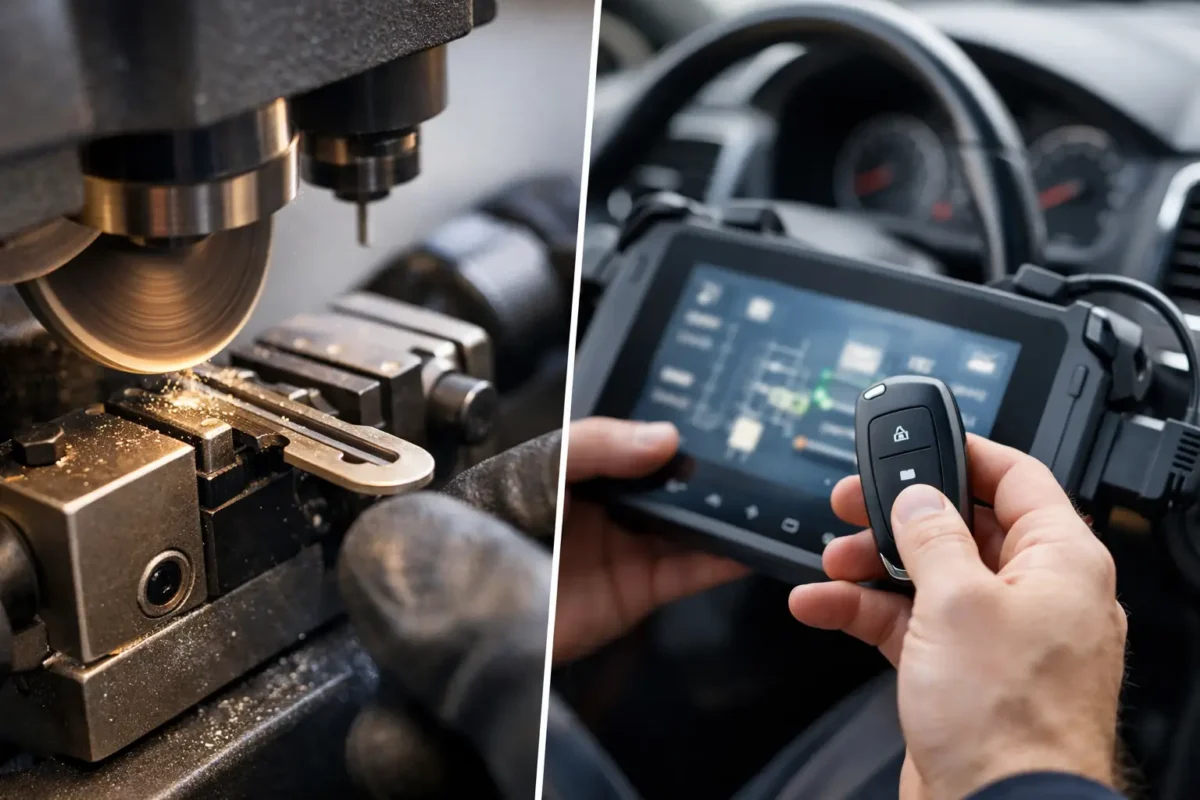
A replacement car key can look finished and still fail to start your vehicle. That is the difference behind car key cutting versus programming: cutting makes the key physically fit the lock, while programming lets the vehicle recognize its electronic security chip or remote. Depending on your vehicle and the key you lost, you may need one service, the other, or both.
For a driver standing in a parking lot with no working key, the distinction is more than technical. It determines what a locksmith needs to bring, what work has to be done on-site, and whether the replacement will only open the door or actually get you back on the road.
What car key cutting does
Car key cutting creates the physical blade that turns in your vehicle’s door lock and ignition. A locksmith cuts the grooves, depths, and edges of a blank key to match your vehicle’s lock pattern. With a traditional metal key, this may be the full job. Once cut correctly, the key should operate the door and ignition.
The key pattern can be created from an existing working key, decoded from a lock, or obtained through authorized vehicle information when appropriate. The right method depends on the vehicle, the condition of the locks, and whether any keys are still available.
Modern vehicles use several blade styles. A standard edge-cut key has visible grooves along one or both sides. A high-security laser-cut key has a center groove and usually requires specialized cutting equipment. Some smart keys include an emergency metal blade tucked inside the fob. Even though that blade may only be used to open the door, it still has to be cut accurately.
Cutting is mechanical work. It does not, by itself, tell the car’s immobilizer system that the key is authorized.
What car key programming does
Programming connects the electronic part of a key to your specific vehicle. Most late-model cars use an immobilizer system designed to prevent unauthorized starting. The key may contain a transponder chip, or the vehicle may communicate with a proximity fob through a wireless signal.
When you insert the key or press the start button, the vehicle checks for a recognized electronic credential. If the chip or fob has not been programmed, the engine may crank without starting, start and immediately shut off, or not respond at all. The exact behavior varies by make and model.
Programming can also cover remote functions, such as lock, unlock, trunk release, panic alarm, and remote start when equipped. A key can be programmed to start the vehicle while its remote buttons still need separate synchronization. That is one reason a complete functional test matters before the job is finished.
A professional automotive locksmith uses vehicle-compatible diagnostic and programming equipment to add, replace, or erase keys as the situation requires. Some models allow straightforward on-board programming. Others require more involved procedures, security authorization, PIN access, or direct connection to the vehicle’s system.
Car key cutting versus programming: when you need each
The simplest answer is that older vehicles with basic metal keys usually need cutting only. Many vehicles made from the late 1990s onward need a cut key with a programmed transponder chip. Push-button-start vehicles generally require fob programming and may also need an emergency blade cut.
Here are common situations where the service needed changes:
- You have a plain metal spare key. A duplicate may only need to be cut, provided your vehicle does not use a transponder chip.
- Your key starts the car but the buttons do not work. The blade and transponder may be fine, while the remote fob, battery, or remote programming needs attention.
- You lost every key. A replacement often requires both cutting and programming, plus a process to establish authorized keys with the vehicle.
- The key turns but the car will not start. The key may be cut correctly but have an unprogrammed, damaged, or incorrect transponder chip.
- You drive a push-button-start vehicle. The fob generally must be programmed, even if an emergency blade is also cut for manual door access.
The vehicle’s year, make, model, and trim matter. Two cars from the same manufacturer can use different key systems, and even a replacement key that looks identical may have the wrong chip type or frequency.
Why a cut key may not start the car
A common misunderstanding is that a new key simply needs the same shape as the old one. That was often true with older vehicles, but electronic immobilizers changed the process. The metal blade allows the key to turn the ignition cylinder. The chip proves to the vehicle that the key is approved.
Think of cutting as making the key fit the lock and programming as giving it permission to start the car. Neither step replaces the other when the vehicle uses both a mechanical lock and electronic theft deterrent system.
This also explains why a key that was copied at a basic key machine may unlock the door but fail in the ignition. The physical copy can be accurate while the electronics are missing or not enrolled in the vehicle.
Key types and what they usually require
Traditional keys are the most straightforward. If there is no chip inside the head of the key, cutting is typically all that is needed. Some basic keys have a plastic head but still do not contain a transponder, so appearance alone is not a reliable test.
Transponder keys have a chip embedded in the head. They need a correctly cut blade and correct programming for starting. The chip does not need a battery to communicate with the vehicle, which is why a dead remote battery does not always prevent a transponder key from starting a vehicle.
Remote-head keys combine the metal blade and remote buttons in one unit. They may need cutting, transponder programming, and remote synchronization. Flip keys work similarly, with the blade folding into the fob.
Smart keys and proximity fobs are used with many push-button-start systems. They are programmed to communicate wirelessly with the vehicle. Most include a removable or hidden emergency key blade that needs cutting for manual entry. If the fob battery dies, the vehicle often has a backup detection method, but the location and procedure differ by model.
What to expect from a mobile locksmith
A qualified mobile locksmith can assess the key system where the vehicle is located, which is especially useful after a lost-key situation, a broken fob, or a lockout. Before making a key, the technician will typically verify vehicle ownership and identify the exact year, make, model, and key type.
The work may include cutting a new blade, supplying the correct transponder key or fob, programming it to the vehicle, and testing every needed function. Testing should cover door locks, ignition operation or push-button start, remote buttons, and the emergency blade when applicable.
If you have lost keys, ask about removing the missing key from the vehicle’s recognized-key memory when the vehicle supports that option. This can reduce the chance that a lost key could later be used to start the car. It is a practical security step, particularly if the key was lost near your home, workplace, or vehicle.
For drivers in Aurora, Federal Heights, Denver, and nearby communities, BS Locksmith can provide on-site help for many car key replacement, cutting, and programming needs. Having the vehicle information ready when you call helps the technician arrive prepared with the proper key blank, fob, and equipment.
Avoid problems with replacement keys
The least stressful time to get a spare key is before the only working key is lost, damaged, or locked inside the vehicle. A working original can make duplication and programming more straightforward, and it gives you a backup for daily use.
Keep the spare separate from your main key ring. A spare in a secure place at home is more useful than a second key that is lost with the first one. For smart keys, replace the fob battery when you notice reduced range or intermittent button response, rather than waiting for a failure during a busy day.
If a key is bent, cracked, intermittently recognized, or requires repeated attempts to start the car, do not force it. A worn blade can damage the ignition, while a failing chip or fob can leave you stranded without warning. Getting the issue checked early is usually simpler than dealing with a complete no-start situation.
When a replacement key is needed, the goal is not merely a key that looks right. It is a key that opens the vehicle, starts it reliably, and gives you a secure backup for the next unexpected moment.