
ADA Door Hardware for Accessible Commercial Doors
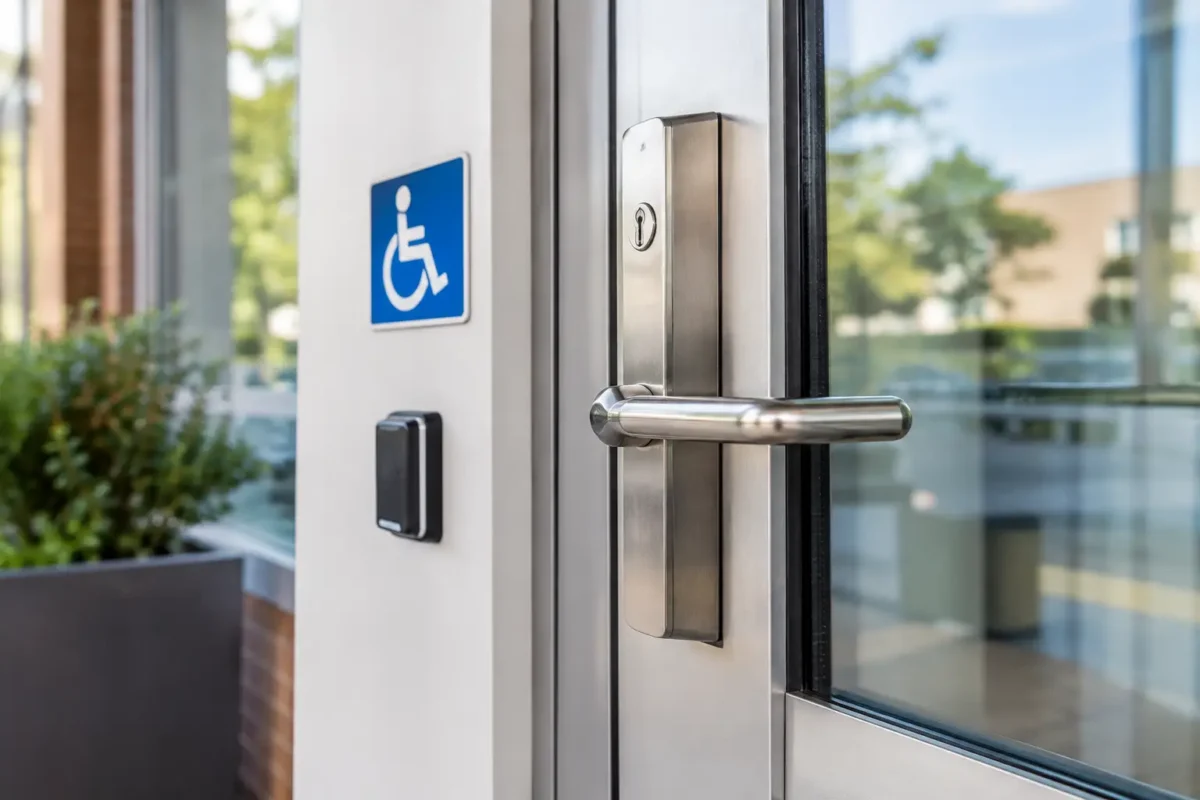
A commercial door can look secure, professional, and well maintained while still creating a daily barrier for customers, tenants, employees, or delivery drivers. ADA door hardware is about making the door usable by people with limited hand strength, mobility devices, prosthetics, or temporary injuries – without sacrificing security or fire safety.
For a Denver Metro business, an accessibility issue is rarely limited to one handle. The problem may involve a stiff closer, a lock that requires twisting, a reader placed too high, or an exit device that takes too much force to operate. Choosing the right hardware early, or correcting a problem during a security upgrade, helps create an entry that works for more people.
What Makes Door Hardware ADA Compliant?
The Americans with Disabilities Act sets accessibility standards for public-facing and commercial spaces. Door requirements can also be affected by local building codes, fire codes, occupancy type, and the authority having jurisdiction. That means compliance is not a matter of buying a product labeled “ADA” and installing it anywhere.
In practical terms, accessible hardware should be easy to identify, reach, grasp, and operate. A person should generally be able to use the hardware with one hand and without tight grasping, pinching, or twisting of the wrist. This is why lever handles, push-pull hardware, panic bars, and properly selected automatic operators are common choices for accessible openings.
Operable parts are generally installed within an accessible reach range, commonly 34 to 48 inches above the finished floor. Hardware must also work with reasonable operating force. For many non-fire-rated interior hinged doors, the opening force requirement is typically no more than five pounds. Fire doors and exterior doors involve additional safety and environmental considerations, so the applicable rules can differ.
The door itself matters just as much as the lock or handle. Closing speed, threshold height, clear width, maneuvering clearance, weather conditions, and door weight all affect whether an entrance is actually easy to use.
ADA Door Hardware That Works in Real Buildings
Lever Handles Instead of Knobs
Round knobs are familiar, but they often require twisting and firm gripping. That can be difficult for someone with arthritis, limited dexterity, or an occupied hand. Lever handles are usually the practical choice because they can be pressed down with a hand, elbow, or forearm.
A lever must still be installed correctly. It needs sufficient clearance from the door frame, a nearby wall, or another piece of hardware. A lever that hits trim before it fully turns is not a usable solution. The latch should also retract smoothly. If the lever feels loose, binds, or requires extra force, service may be needed before the issue becomes a lockout or accessibility concern.
Exit Devices and Panic Bars
Exit devices are common on restaurants, offices, retail spaces, schools, and other commercial buildings where fast egress is required. A properly selected panic bar allows occupants to open the door by pushing on a broad surface rather than turning a small latch.
Not every exit device is configured the same way. The mounting height, projection, latch operation, door width, and fire rating all matter. For double doors, coordination between active and inactive leaves can also affect accessibility. If one door leaf is intended as the accessible route, it must provide the needed clear opening and operate without unnecessary steps or excessive force.
Door Closers That Do Not Fight the User
A door closer protects the door, supports security, and is often required for fire-rated openings. It can also become the biggest obstacle at an entrance when it closes too quickly or requires too much force to open.
The ADA standards generally require a hinged door with a closer to take at least five seconds to move from 90 degrees open to 12 degrees from the latch. That gives a person time to pass through safely. Adjusting a closer is not simply about making it loose. It requires balancing sweep speed, latch speed, backcheck, door control, weather exposure, and fire-door requirements.
A closer that slams, drags the door shut, or leaves the door barely able to latch needs attention. On the other hand, a door that will not close and latch reliably can create a security risk. The right adjustment protects both access and the building.
Accessible Locks and Electrified Hardware
Deadbolts, mortise locks, cylindrical locks, and access control hardware can all be part of an accessible opening when selected and installed correctly. The user-facing operation is what matters. Thumbturns, keypads, credential readers, request-to-exit devices, and release buttons should be located where users can reach them and should not demand a tight grip or complicated motion.
For access-controlled doors, it is easy to focus only on the card reader. However, a reader does not solve an accessibility problem if the door still has a heavy closer, an awkward pull handle, or no practical way to open it after credentials are accepted. In some settings, a low-energy automatic operator may be the better answer.
Electrified hardware must also be coordinated with life-safety requirements. A commercial locksmith can help with the hardware side of the installation, but building officials and fire authorities may have requirements for egress, emergency release, wiring methods, and door labeling. This is especially important for fire-rated doors.
Automatic Door Operators
Automatic operators can make a high-traffic or heavy entrance much easier to use. They are often a strong option for medical offices, apartment common areas, retail businesses, professional offices, and buildings that serve the public.
A low-energy operator normally opens after a user activates a push plate, wireless actuator, keypad, or approved access control device. The actuator must be placed where it is reachable from a safe, usable location. A button mounted behind a planter, across a narrow landing, or too close to a swinging door does not help much.
Automatic doors require ongoing service. Sensors, push plates, arm assemblies, hinges, closing force, and hold-open timing must work together. A door that opens unpredictably or closes before someone can pass through is not just inconvenient. It can create a safety issue.
Common Problems Property Owners Miss
Accessibility issues often develop over time rather than appearing on the day a door is installed. Seasonal temperature changes can affect door alignment. A settling frame can make latches bind. New carpeting or flooring can reduce clearance. A well-meaning maintenance adjustment can increase closer force until the door is difficult to open.
Property managers should also watch for hardware changes made after a tenant moves in. Adding a keyed deadbolt, surface bolt, decorative pull, or security plate may change how the opening works. A locked door can be secure without requiring users to perform a difficult sequence of motions.
The following quick check can reveal problems worth addressing:
- Can the door be opened with one hand without twisting a knob or using a tight grip?
- Does the hardware sit in an accessible reach range and clear nearby trim or walls?
- Does the door close slowly enough for a person using a cane, walker, or wheelchair?
- Does the latch engage reliably without requiring the user to shove or pull hard?
- If access control is installed, can the user reach the reader or actuator and then open the door without a struggle?
When a Hardware Upgrade Is the Right Move
Sometimes a closer adjustment or a minor repair is enough. Other times, the existing door setup was never a good fit for the building. A retail storefront with a heavy aluminum-and-glass door may benefit from a properly configured operator. An office with knobs on restroom or meeting-room doors may need lever hardware. A business using older keys may combine an accessible lever set with a new key system or electronic access control.
The best choice depends on the door type, traffic volume, security level, fire rating, weather exposure, and who uses the building. A busy exterior entrance needs a different solution than an interior supply closet. There is no one-size-fits-all piece of ADA hardware.
For commercial property owners in Aurora, Denver, Federal Heights, and nearby communities, BS Locksmith can assess door hardware, repair problem locks and closers, and install practical security upgrades. The goal is straightforward: doors should secure the property, allow safe exit, and give customers and employees a reasonable way to get in and out.
A door is part of the customer experience before anyone reaches the counter or reception desk. When it opens easily and latches securely behind them, the building is doing its job.