
When to Book an Office Lock Rekey Service
A lot of office security problems start with one simple question nobody can answer: who still has a key?
That is usually the point when an office lock rekey service makes sense. If an employee left without returning keys, a contractor had temporary access, or your business moved into a suite with existing hardware, rekeying gives you control again without replacing every lock from scratch. For many offices, it is the fastest way to tighten security and keep daily operations moving.
What an office lock rekey service actually does
Rekeying changes the inside of an existing lock so the old key no longer works. The lock body often stays in place, but the internal pins are adjusted to match a new key. That means you can keep compatible hardware and still cut off access tied to old keys.
For an office, that difference matters. A full lock replacement can be the right move when hardware is damaged, outdated, or no longer fits your security needs. But when the locks are in good shape, rekeying is often the more practical fix. It addresses the key-control problem directly without changing more than necessary.
This is why rekeying is common after staffing changes, lease turnovers, management transitions, and lost-key situations. The issue is not always the lock itself. The issue is uncertainty about access.
When rekeying is the smart move
Not every office security issue needs brand-new hardware. In many cases, rekeying gives you the result you need with less disruption.
If an employee, tenant, vendor, or cleaning crew member had access and no longer should, rekeying helps restore control quickly. The same applies when keys are lost, copied, or never collected back. A key does not need to be stolen to become a risk. If you cannot account for it, that is enough reason to take the problem seriously.
Rekeying also makes sense when you move into a new office. Even if the previous owner or tenant hands over every key they have, there is no reliable way to know how many copies exist. A fresh key setup removes that guesswork.
Property managers and business owners also use rekeying as part of routine security updates. If your office has had years of staff turnover and no clear key policy, an office lock rekey service can reset the system and make future control much easier.
When rekeying is not enough
Sometimes the better answer is replacing locks, not rekeying them.
If the hardware is worn out, sticking, damaged, or low-grade for a commercial setting, rekeying will not solve those underlying issues. The same goes for offices that need stronger key control, upgraded commercial hardware, panic devices, or access control. Rekeying is useful, but it works within the limits of the lock you already have.
There are also cases where offices want to move away from standard keys altogether. If you are dealing with frequent staff changes, multiple entry points, or after-hours access for different teams, a keypad, smart lock, or full access control setup may be easier to manage than physical keys.
That is where a good locksmith helps you sort out what fits the property instead of pushing one answer for every door.
Office lock rekey service for one door or a whole system
Some businesses only need one lock rekeyed. Others need a full office suite, several interior doors, storage rooms, and back entries brought under one clean key plan.
That is an important part of commercial rekey work. It is not just about making old keys stop working. It is also about organizing access in a way that makes sense for the people using the building.
For example, an office may want the front and rear doors on the same key, while keeping the IT room, records room, or supply closet on separate access. Another business may want a master key system so management can open every door, while individual staff can only access certain spaces. Rekeying can often support that kind of structure if the hardware is compatible.
This is where commercial experience matters. Office security is rarely just one lock and one key. It is usually a mix of convenience, control, and practical limits.
What to expect during the process
A professional office lock rekey service starts with identifying what hardware is installed and what outcome you want. Some offices want every lock changed to one new key. Others need a more layered setup with restricted access between rooms.
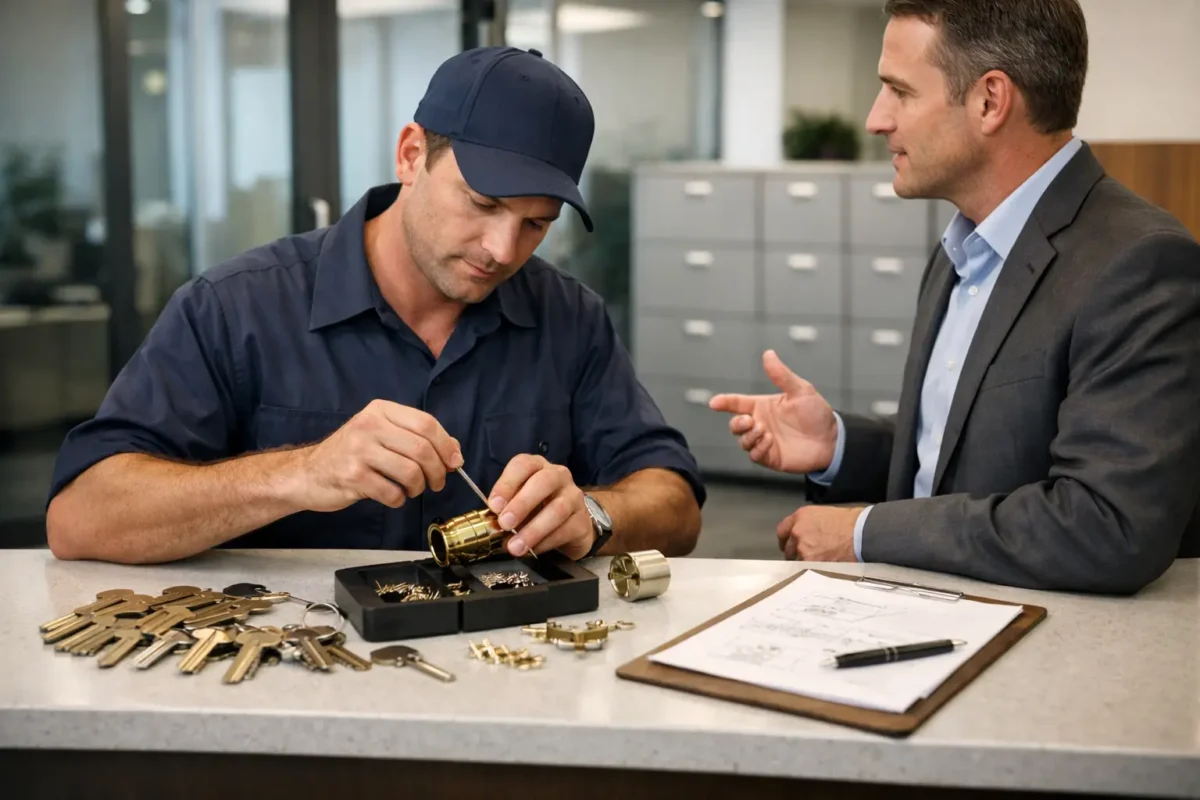
Once the locks are evaluated, the locksmith removes the cylinders or otherwise accesses the pin chambers, changes the keying, tests the locks, and cuts the new keys. If any lock is not worth rekeying because of wear or compatibility issues, that usually becomes clear during inspection.
For a business, the biggest concern is often interruption. The good news is that rekeying is generally less disruptive than replacing every lock. In many cases, the work can be done on-site with minimal impact on staff and operations.
It also gives business owners a chance to clean up old key habits. Instead of handing out duplicates from an inconsistent system, you start over with a known key count and a clearer access plan.
Why key control matters more than many offices think
A surprising number of businesses focus on alarms, cameras, and cybersecurity while overlooking physical key control. But a basic key issue can undercut every other security measure in the building.
If former staff, past vendors, or unknown key holders can still open a side door or office suite, you have a gap that software cannot fix. Rekeying closes that gap at the point of entry.
It also helps with accountability. When your office has a current key structure, you know who has access and where. That matters for employee safety, sensitive files, inventory, equipment, and after-hours entry.
For small and mid-sized businesses, this is often one of the most cost-effective security steps available. Not because it is cheap, but because it solves a real exposure without requiring a complete overhaul.
Signs your office should not wait
Some situations call for immediate action.
If keys were lost with identifying information attached, if a break-in involved attempted entry through existing locks, or if a recent separation with an employee or tenant ended badly, delaying rekeying creates unnecessary risk. The same goes for offices that have been passing keys around informally for years and can no longer say how many copies are in circulation.
Another warning sign is internal confusion. If your team regularly says things like, “Try the old key,” or, “I think someone in maintenance has a copy,” your access system is already too loose.
Businesses do not always need a major security project. Sometimes they just need to get control of the doors again.
Choosing the right locksmith for office rekey work
Commercial rekeying is straightforward in concept, but offices often have more moving parts than expected. Exterior doors may use different hardware than interior doors. Some locks may be standard cylinders, while others are tied to storefront hardware, lever sets, or restricted keyways.
That is why it helps to work with a locksmith who handles both urgent service calls and planned commercial security work. You want someone who can rekey what should be rekeyed, flag what should be replaced, and keep the setup practical for daily business use.
A mobile locksmith is especially useful when you need work done on-site and on schedule. For businesses in Aurora, Denver, Federal Heights, and nearby areas, that local response can make a big difference when access needs to be fixed fast and correctly.
BS Locksmith handles office rekeying with the same approach business owners want from any service call – show up prepared, explain what makes sense, and get the security issue handled without wasting time.
A better time to rekey than after a problem
Most offices wait until something goes wrong. A key goes missing. An employee leaves suddenly. A landlord turnover creates confusion. Then the rekey happens under pressure.
The better move is to treat rekeying as part of normal business security. After a move, after turnover, after construction, or after any access change, resetting your locks can prevent bigger problems later.
If you are not sure who still has a key to your office, that uncertainty is already your answer. Getting the locks rekeyed is a practical step that puts control back where it belongs – with the business owner or manager responsible for the property.